Showing posts with label The Lijadu Sisters. Show all posts

Jan 21, 2014

Rediscovering The Lijadu Sisters!

http://felaonbroadway.makemighty.com/wp-content/uploads/2011/11/lij1.jpeg

We first came across The Lijadu Sisters a few years ago on an afro psychedelia compilation and they quickly became a much-loved favorite of ours. We were therefore incredibly excited when we discovered that Knitting Factory Records last year started re-issuing the sisters’ four long out of print albums – and even more excited when we recently got the chance to ask Knitting Factory’s Tim Putnam about the sisters, their unique story and the long process of bringing their fantastic music out of obscurity. Read the interview and listen to some Lijadu tunes below. Then check out Alex Petridis’ great review of ”Afro-Beat Soul Sisters” and buy your Lijadu albums here.

How did you first come across Taiwo and Kehinde Lijadu?

I was introduced to the Lijadu Sisters by Will Glasspiegel who was working with the sisters at the time. He approached me as our label was in the process of rereleasing the entire Fela catalogue along with Seun’s and Femi’s records as well. He thought we’d have interest since the sisters are Fela’s cousins and the music is so engaging. I then got to meet the sisters who were living up in Harlem. I had never in my life met two people so closely tied together on every level as Taiwo and Kehinde and was drawn to them.

What made you want to take them out of obscurity?

The music, the incredible story, and ultimately getting to know the sisters themselves.

How did you manage to convince the sisters to re-issue their albums? I’m sure you where not the first ones to try your luck in this.

It wasn’t me who convinced them. I don’t think anyone convinces them of anything. They were the ones who decided over a long period of time what they wanted to do. It was the better part of two years between meeting the sisters and them wanting us to release the albums before we were able to come to an agreement. That is really its own story altogether.

Their records have been out of print for years. But are there other factors that might explain why it has taken so many years for the sisters to receive the reserved recognition? 

The sisters did receive recognition when the albums were first released, but their music ultimately became obscure and increasingly rare in physical formats reserved for collectors and enthusiasts. The practicality of what often happens to so many musicians over time doesn’t lessen the quality of lasting relevant music. As you said, the records were out of print and very difficult to get.  We had to locate good copies of vinyl to master from which was a painstaking task as the original reels / tape no longer exist. We still have never been able to locate the very first album they released called Urede. I found an old print ad for it so I know it exists, but I have as of yet never been able to find the album. Bringing this music back to life simply allowed people to recognize the sisters once more for what they are as two beautiful and unique songsmiths.

Their story – two independent female artists in the 1970s Nigeria – seems quite unique as does their intriguing mix of disco, funk, reggae, highlife and psychodelic rock etc. Do you see them as being something of an outlier compared to mainstream Kuti-dominated afrobeat? 

I don’t see them as being anything other than two extremely gifted individuals who took a number of influences and created their own sound musically. They have always done things on their terms and continue to do so in every aspect of their lives. Fela did the same thing creating afrobeat on a massive level, but he didn’t have a twin brother to harmonize with. The sisters are utterly unique in that regard. Two voices which act as a singular voice. It is why their music stands out from a lot of other music, not just African.

How have the sisters reacted to their reemergence after decades on relative obscurity?

I can’t really speak for the sisters on that point. I will say that the sisters have always looked towards the future and the music they want to make, not just the music they have made. Hopefully this will allow them to move forward with their career.

Any chance of seeing the sisters back on stage?

I hope so. They played a benefit show for a school for the blind last year in NY which made for a very special evening and gave me hope that they will continue to perform. They have sung to me many times in the past. It is both spiritual and deeply moving. I really hope others get to see them sing live again on their terms with the right mix of musicians. They are very particular about who they play with and there aren’t Yoruba drummers on every corner in NY.

The trend of DJs, vinyl diggers and labels from ”the West” traveling to Africa to (re)discover old vinyl gems has started to receive some criticism for being ”neo-colonial” in focusing mainly on artists within funk or rock that fit well into the exotic musical story expected from Africa and ignoring the more traditional music. Is this a fair point in your view? And how do you see the Lijadu Sisters fitting into this picture? 

I don’t think that is a fair point of view. As far as we know, we’re all from Africa originally and so is all of our music. It has just evolved over the last several tens of thousands of years constantly splintering and changing into what it is today. People have lost perspective on what it is to be human and how we are all related. Neo-colonialism simply doesn’t apply to finding relevant music and sharing it with other people. The Lijadu Sisters have many traditional elements in their music far beyond just being funk or rock. Keep in mind as well, a lot of this music has a political and social element which have resonating themes today as much as it did when it was written. That is a large part of the lasting appeal.

Danger and Mother Africa have been reissued in the past months. What’s up next? Any other African musical treasures up your sleeves?

We have two more Lijadu records as well with Sunshine and Horizon Unlimited. We just released Fela Live In Detroit 1986 which is the first new Fela release in a number of years as well. Hopefully they’ll be much more to come.

addisrumble.com 


Oct 14, 2011

The Lijadu Sisters - Danger


In 1970s Nigeria, only a tiny handful of female artists broke through the backing singer/dancer ceiling to become stars in their own right, particularly if they wrote their own material -- And Fela cousins The Lijadu sisters did just that. Their repertoire ranged from love songs and dance anthems to philosophy and political/social commentary. “The music business was hard for women in Nigeria,” says Taiwo Lijadu. “Back then, they didn’t think women had brains.”

Twins Taiwo and Kehinde were born in Jos, in northern Nigeria, on October 22, 1948. They enjoyed singing from an early age, encouraged by their mother, who bought them records by a wide range local and overseas of artists. Kehinde and Taiwo remember with special fondness discs by Aretha Franklin, Miriam Makeba, Ray Charles and, later, Fela Kuti (who, like the Nobel Prize winning writer and political activist Wole Soyinka, was their second cousin).

The Lijadu Sisters began working as session singers, but solid-gold talent and determination – and, no doubt, the twins’ extraordinary physical beauty - soon led to their first own-name release, “Iya Mi Jowo” (“mother please”), which came out on Nigerian Decca in 1968. The song was written by Taiwo in 1965 and the story behind it is included in the notes for the album Mother Africa, for which the sisters rerecorded it.

In 1971, the sisters met the British drummer Ginger Baker (Cream, Blind Faith, Airplane), who in the first half of the 1970s was a frequent visitor to Nigeria, where he recorded and performed with Kuti and his band, Africa 70. In 1972, the Lijadu Sisters performed with Baker’s band at the cultural festival accompanying the Munich Olympics in Germany. For a while, Taiwo and Baker were an item. Another fortuitous male encounter was with the multi-instrumentalist Biddy Wright. Wright’s mother was a close friend of the sisters’ mother, through whom the three met. Sadly no longer with us, Wright co-arranged and played on all four of the classic 1970s Lijadu Sisters albums released on Decca’s Afrodisia imprint, which are now being re-released by Knitting Factory Records – Danger (1976), Mother Africa (1977), Sunshine (1978) and Horizon Unlimited (1979).

In 1988, they visited the US with Sunny Ade, and performed under their own name with Ade’s band, winning an enthusiastic review in The New York Times. By the end of the decade, things were looking good for the Lijadu Sisters in the US, and after the Ade concerts they stayed in the country while their green card applications went through.

Then disaster struck. Kehinde suffered dreadful spinal injuries in a fall in the hallway of the twins’ Brooklyn apartment building (they lived on the first floor). “The first doctor who saw me gave me six months to live,” says Kehinde. “Then they said I would never walk again. But I said to myself, ‘I will be strong, I will not give up, I owe it to my family.’” The accident threatened to finish the Lijadu Sisters’ career, and it kept them out of the public eye until 2011, when Knitting Factory’s reissue program began. While Kehinde was recovering, the twins withdrew completely from the limelight. Inevitably, rumors about their wellbeing and whereabouts abounded. Some people thought they had died, others that they had married rich Americans and retired into lives of luxurious obscurity. There were several other tales. Everyone missed them terribly. Kehinde eventually overcame her injuries, but it took many years, and she still suffers its effects. “I am walking, even dancing again now,” she says. “But I cannot sit down for more than two hours at a time, and I cannot fly any distance at all.” During Kehinde’s recovery, the sisters’ were sustained by their embrace of the traditional Yoruba belief system Ifa (which has a divination strand of arcane complexity and infinite nuance), and their study of the use of herbs in healing. “Our mother taught us that unless we had something to promote, it was best not to do interviews,” says Taiwo. “Save it for when you have something to talk about. And we have not spoken for a long time. But the Knitting Factory program means we have something to talk about once more. We are back, and we are going to perform again.” Adds Kehinde,“It is decades since we have performed publicly, but now we are ready - and the music will be of today! We thank our fans for remembering us, and we want them to know why we have been silent. We love them very much.”

In 2011, Kehinde and Taiwo, inseparable since birth, share an apartment in Harlem, NYC. It is wonderful to have them back.

felaonbroadway.com

---


---

The Lijadu Sisters’ Afrodisia debut, 1976’s Danger, is as funky and mellifluous as it gets, the twins’ gorgeous harmonies underpinned by a solid Afro-rock beat and framed by Wright’s funky organ and guitar work. Danger has a vibe of uplifting positivity which would be a feature of all four of the Lijadu Sisters’ Afrodisia albums.

Lyrically, most of the songs address social and political issues, sometimes directly, sometimes through metaphor and allusion. The uptempo opener, “Danger,” is on one level about a “dangerous lover.” But in the wider context of the times – with the police and army’s abuses of power running rampant and otherwise unchecked (Fela Kuti’s eviscerating Zombie was also released in 1976) – it captures life on the edge in contemporary Nigeria.

“Danger” has a bridge which is almost identical to the one used by Jamaican artists Althea & Donna on “Uptown Top Ranking” and Trinity on “Three Piece Suit.” Intriguingly, both these records were released a year after “Danger.” Kehinde and Taiwo put it down to something that was in the air at the time. That said, it remains a remarkable coincidence.

In Yoruba, “Amebo,” which follows, literally means “someone who gossips.” The twins here extend the word to mean they are watching the powers that be – “your office of power” and “the work you have done” – and will not be afraid to speak up about wrongdoing and incompetence.

They do just that on “Cashing In,” which addresses the complacency and corruption of the Nigerian ruling elite in general, and in particular the then-recent revelation that government ministers were flying prostitutes into the country at the tax payers’ expense. Such people are cashing in, sing Taiwo and Kehinde in the refrain, while “poverty’s a common sight.”

The slow and mournful “Lord Have Mercy,” which closes the album, returns, heartbreakingly, to the idea of poverty amidst national economic wealth. It tells the story of a boy the twins saw “dying on the street…children starving; mama’s dead, poppa’s gone; life is wasted; Lord, have mercy; Lord, hear me crying.” In fact, this particular child was taken in by a concerned passer by – but the lyric doesn’t reveal that, because Kehinde and Taiwo realised a happy ending would let listeners off the hook.

The remaining tracks, “Life’s Gone Down” and “Bobby,” are respectively an example of the Lijadu Sisters’ signature positivity (“it’s not too late, if we hurry; people get together, life’s gonna get good”), and a rock-steady infused love song.

knittingfactoryrecords.com

---

Knitting Factory Records - home to all things Fela Kuti, natch - is set to re-release of four long out-of-print albums by Nigerian twins the Lijadu Sisters, Taiwo and Kehinde. The sisters, cousins of Fela, were a rarity in Nigeria. Not only were they female in an industry dominated by male artists but they wrote their own material, which was often political and always topical. Recorded at the famed Decca studios in Lagos, Nigeria, the hotbed of the Nigerian music scene at that time, the albums combine Afrobeat, Western and UK pop music and reggae, with the sisters singing in both English and Yoruba.

The releases are as follows:

Danger (1976) - November 8, 2011
Mother Africa (1977) - 1st quarter 2012
Sunshine (1978) - 2nd quarter 2012
Horizon Unlimited (1979) - 3rd quarter 2012

Long out of print and prized by collectors, these albums have never before been available on CD or digitally; they'll also be available on vinyl and all formats will include the original artwork. Remastered from recordings taken off the original vinyl LPs (the tapes have long been lost), these recordings sound as urgent and timely today as they did set against the turbulent scene of Nigeria in the '70s.

The series will kick off with Danger on November 8, 2011; the Lijadu Sisters' first release on the Afrodisia label. Danger is as funky and mellifluous as it gets, with the twins' gorgeous harmonies underpinned by a solid Afro-rock beat and framed by multi-instrumentalist Biddy Wright's funky organ and guitar work. Danger has a vibe of uplifting positivity which would be a feature of all four of the Lijadu Sisters' Afrodisia albums.

Lyrically, most of the songs address social and political issues, sometimes directly, sometimes through metaphor and allusion. "Danger," the uptempo opener and title track, is on one level about a "dangerous lover." But in the wider context of the times - with the police and army's abuses of power running rampant and otherwise unchecked (Fela Kuti's eviscerating Zombie was also released in 1976) - it serves as a glimpse of life on the edge in Nigeria during those turbulent political years.

The reason the Lijadu Sisters aren't well known today, except by collectors, is that Kehinde, while the duo was touring North America with King Sunny Ade in 1980, suffered a severe spinal injury that has kept them out of the public eye until now. They're living in NYC and have been very hands on with the project, working with Knitting Factory Records to make these albums available again. The sisters are also planning select shows timed around these releases; stay tuned for updates.

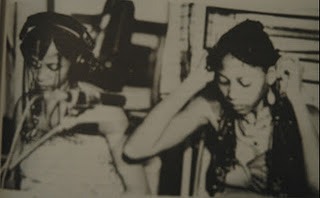
The Lijadu Sisters were featured in Konkombé, British director Jeremy Marre's 1979 film on the Nigerian pop scene and were a hit in the '80s on the UK television show, The Tube. Check out this clip of The Lijadu Sisters at Decca Studio in Lagos in the '70s:


blurt-online.com


Tracklist

01. Danger
02. Amebo
03. Life’s Gone Down Low
04. Cashing In
05. Bobby
06. Lord Have Mercy