Feb 13, 2014

From Congo: Orchestre Vévé


'African grooves with a more laidback feel can be found on this excellent retrospective. Leader Verckys is one of the titans of Congolese music, a former Franco associate whose exploration of the region's folkloric rhythms like the cavacha was laregly responsible for the soukous beat which followed. The ten tracks here are magnificent, upful rhythm zephyrs.'
Verckys Kiamuangana Mateta is one of the most influential figures in the history of Congolese (Zaïrean) music. As a saxophonist, composer and bandleader he was able to rival both Franco and Rochereau. He developed his own honking, gutbucket style of sax playing which characterised some of the most exciting music of the 1960s and 70s.

Verckys was a great showman who liked to play up to the crowd. He really let fly during the sebenes occupying a musical space which had previously been the preserve of solo guitarists only. After generating some raucous excitement as a member of OK Jazz he founded Orchestre Vévé in 1969. He has been credited with creating the cavacha beat that led on to soukous. In effect, Verckys’ unique studio sound, his unerring ear for talent and unquenchable enthusiasm turned him into the godfather of modern Congolese music.

retroafric.com


http://ntwiga.net/linked_to_images/orchestre_veve_baluti_I.jpg

 Tracklist
  1. Sakumuna 5.11
  2. Baluti 9.33
  3. Marcelo Tozangana 5.27
  4. Ah Ngai Matinda 5.49
  5. Bea 5.20
  6. Bilobela 10.19
  7. Londende 9.30
  8. Mama Djele  4.40
  9. Mikolo Mileki Mingi  8.02
  10. Vivita  9.42

Feb 12, 2014

Stanley Murphy – Dzeu Fur Lô Mê-hon


Consistent hybrid funky fusion afro pop LP from Ivory Coast.


Tracklist

A1 Dzeu Fun Lo Me Hon
A2 Yapo Dadié Michel Béchéké
B1 Beda Achi Yako
B2 Me Houe Ze Me Tan


Feb 10, 2014

Survival – Simmer Down


While bands like Ofege and BLO have slowly becomes household names for collectors, there are still many Nigerian bands and albums that have remained unknown in most circles.  Survival’s lone effort ‘Simmer Down’ is one of those albums.  Primarily an Afro Rock album, it contains psychedelic, soul, afrobeat, funky and progressive moments, all done in a raw nature with unpolished mixes and an underlying consistency that doesn’t lose the listener.  Songs are filled with fuzz guitar solos, flute solos & organ solos.  Recorded by a group of talented High School students at the legendary ARC studio owned by ex-CREAM drummer Ginger Baker, this album seems to have remained under the radar until now.  Filled with complete notes by the band with photos and history, including a story detailing a battle against OFEGE at the infamous ‘Space Funk’ competition.  A limited edition pressing of 1000 copies on LP, with insert and photos and 800 CD with 12 page booklet.  A gem from Nigeria, and one you won’t find an original for anytime soon.

strawberry-rain.com

Tracklist

A1 Ripples
A2 Survival
A3 Meditation
A4 Emotions
B1 Simmer Down
B2 Own Kind of Trouble
B3 Jungle Justice
B4 Chewing Dust
 
Check out price for original copy @ popsike.com 

Feb 8, 2014

Tony Allen: An Autobiography Of The Master Drummer Of Afrobeat!


First of all, drummers are going to love this book. With so few autobiographies of drummers in print, the publication of Tony Allen: An Autobiography of the Master Drummer of Afrobeat is a cause for celebration. Co-author Michael Veal, author of Fela: The Life and Times of a Musical Icon and an accomplished musician himself, brings to life the rhythm and emotional timbre of Tony Allen's speaking voice and the complex story of this singular, Lagos-born-now-expatriate musician in a first-person narrative that takes the reader through a particularly transformative time in West Africa's post-colonial history. Most importantly, the book is a hell of a lot of fun to read, although Allen's first-hand accounts of his struggles with shamanistic bandleader and Nigeria's adopted "black president" Fela Anikulapo-Kuti will piss off any musician who has had to fight to get paid for playing a gig. And Allen's chillingly matter-of-fact recollection of the aftermath of the 1977 military raid on Fela's "Kalakuta Republic" compound, a raid that involved beatings, rape, mutilation, and nearly burning the compound to the ground, is truly terrifying.

 Swinging Like Hell!

Afrobeat, a musical genre that Veal describes as Nigeria's "sonic signature," was born out of Allen's mastery of what he describes as "a fusion of beats and patterns," including highlife, rumba, mambo, waltz-time, traditional music from Nigeria and Ghana, American R&B and funk and, not surprisingly, jazz. On Allen's first U.S. tour with Fela's band Koola Lobitos, a band that would be renamed Africa 70 upon its return to Nigeria, Allen heard and met drummer Frank Butler, who played drums with such musicians as Duke Ellington, Miles Davis, and John Coltrane. Allen cites the drumming techniques he learned directly from Butler as "the final piece of the puzzle that just made everything catch on fire."

And catch on fire it did. In his vivid description of Allen's drumming on the track "Fefe Naa Efe" from Fela and Africa 70's 1973 album Gentlemen, Veal writes: "Like the great jazz drummers, (Allen) keeps a steady conversation with the other instruments, particularly the soloists...Like a great boxer, he knows when to jab with his bass drum in order to punctuate a soloist's line, when to momentarily scatter and reconsolidate the flow with a hi-hat flourish, when to stoke the tension by laying deeply into the groove, and when to break and restart that tension by interjecting a crackling snare accent on the downbeat."

The book not only reveals Allen's methodical, years-long development of a new way to play the drum kit and propel Fela's compositional and political vision, it also shows Allen never stopped developing his technique post-Fela and continues to bring "the vitality of Yoruba artistic creativity" into new and innovative creative contexts. Allen negotiated the "world beat" market of the 1980s and 90s and experimented, like many African musicians recorded during those years, with heavily electronic and dub production techniques. In recent years, Allen has recorded and performed with American, French, and British musicians from genres that may seem light years away from his highlife roots. He saves some of his highest praise in the book for Damon Albarn, formerly the lead singer and bandleader of the wildly popular British band Blur and who has collaborated with Allen on several projects. "The way Damon came into my life," says Allen, "it was kind of like it had been written...not only did this guy make a big difference in my career, but we are also very good friends."

After many years of being underpaid and under appreciated for his innovations, Allen is currently enjoying a creative renaissance. One of the most moving passages in the book comes toward the end when Allen, now in his 70s, describes how busy he is "touring all over" Europe and what drives his creative work ethic. "I still want to play something impossible," Allen writes, "something that I never played before."

allaboutjazz.com
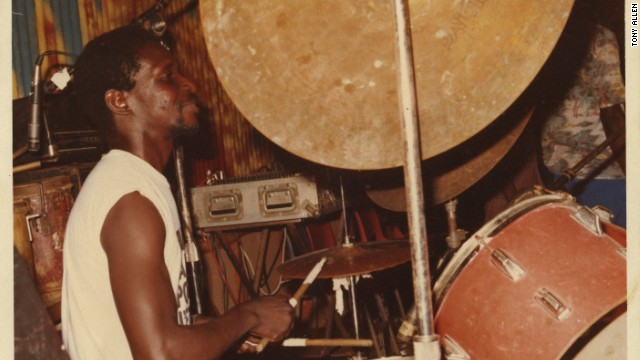

Nigerian drummer Tony Allen is famous for helping create Afrobeat as member of Fela Kuti's Africa 70 band.

'I still want to play something impossible': Meet Afrobeat king Tony Allen

 The first thing he asked was 'Are you the one who said that you are the best drummer in this country?' I laughed and told him, 'I never said so.' He asked me if I could play jazz and I said yes. He asked me if I could take solos and I said yes again."

That's how Tony Allen details his first ever encounter with Fela Kuti back in the mid-1960s, a meeting that was destined to trigger an explosive sonic collaboration that a few years later gave birth to the blistering Afrobeat sound -- arguably the most exciting period in the history of popular West African music.
This anecdote, and many more others, are featured in the newly released autobiography of Allen, the iconic Nigerian drummer who's left an indelible stamp on the history of world music with his distinctive style and pioneering grooves. Brian Eno has hailed Allen as the "greatest living drummer."

Co-written with Michael E. Veal, "Tony Allen: An Autobiography of the Master Drummer of Afrobeat" follows Allen's life from his early days growing up in the heart of Lagos Island, though his struggling first steps as a badly paid freelance musician, the meeting with Fela and the heights of their "Africa 70" band, to his departure from the group and his relocation to Paris in the mid 1980s.

Master drummer

Born in Lagos in 1940 to a Nigerian father and a Ghanaian mother, Allen was the oldest of six children. His first gig came in late 1950s when he started playing clefs in a highlife group called "The Cool Cats," before taking over the band's rhythm section.

From then on, Allen went on to hone his self-taught drumming skills by dipping into different styles as a member of several other Lagos bands -- including "Agu Norris and the Heatwaves," "The Paradise Melody Angels" and "The Western Toppers."

In 1964, Allen met up with Fela and his career took a different, more exciting path. Over the next 15 years, Allen would be the rhythmic engine for the Nigerian multi-instrumentalist and political rights activist, first for the highlife-jazz outfit "Koola Lobitos" and then for the seminal "Africa 70" group.

It was after the band returned from a 10-month stay in the United States in 1969 that Allen created the potent drumming concept of Afrobeat, fusing the different beats and patterns he'd heard while growing up with the new techniques he'd mastered as a professional drummer -- everything from highlife and traditional Nigerian music to Western jazz, funk and R&B.

"I was looking for something," Allen says, from Paris, where he is currently based. "I wanted to be myself," he adds. "I played like everybody already but there was no point in continuing doing that because I'd be bored completely."

Allen, the only member of Fela's band allowed to compose his own parts, could famously drum in a different time signature with each of his four limbs. Driven by his fluid and steady drumming, Africa 70 went on to record a string of highly successful and politically charged albums, which turned Fela into a huge musical and countercultural icon in Nigeria and abroad.

But it was onstage where the full force of Afrobeat's intoxicating sound and the talents of Fela and Allen really shone through.

"With me and Fela, it's a question of telepathy," Allen says of the musical closeness he enjoyed with "Africa 70's" firebrand leader.

"That is why I was able to stick around this guy for 15 years -- you know, I never did that with anyone before; the maximum time I stayed in a band was one year," adds Allen.

"Since I met him I knew that this guy had something, this is the type of challenge I needed ... I just believed that I am meeting a genius and it's great to work with a genius."

Life after Fela

This deep appreciation of Fela's musical brilliance oozes through the pages of Allen's autobiography. But the narrative is also filled with wrangles over payments and recognition. In the end, Allen says it was not the ongoing pay disputes but the increasingly volatile situation around Fela's political activism that led to Allen leaving the group in 1978 -- events like the army attack on Fela's compound in 1977.

"The only thing that happened was that it became a package of madness," Allen says. "I stood it for a while too, I was inside it -- I had been arrested, I had to submit myself because he is like my brother."

Allen's departure left a big void in the heart of the Afrobeat sound. Fela, who replaced his polyrhythmic sideman with four drummers during live performances, once said that "there would be no Afrobeat without Tony Allen." The two remained friends until Fela's death in 1997.

After leaving "Africa 70," Allen went on to form his own bands in Nigeria before relocating to Paris in 1985.
Since then, he's released several well-received albums. A musician committed to innovation, he's joined forces with an eclectic roster of both African and international musicians over the years-- including Damon Albarn, King Sunny Ade and Jimi Tenor.

Today, at the age of 73, Allen still remains as active as ever.

"I don't see the end of exploring," says Allen, who is currently working on a new album. It's a sentiment echoed in his final remarks in the book.

"I still challenge myself every time with my playing," Allen writes. "I still want to play something impossible, something I never played before."


 http://www.dustygroove.com/images/products/a/allen_tonya_tonyallen_101b.jpg

Feb 7, 2014

How African Music is Winning the West


Joshua Bullock explores the immense impact newly digitised African music is having on the West.

As Western bands increasingly investigate the ever-expanding volume of releases and re-releases from the African continent, with the help of discerning European labels like Analog Africa, Soundway and Honest Jon’s, how long will it be before the way we are adapting these forms becomes parody?


Perhaps when we start getting it wrong. So many of these cross-cultural collaborations are just so damn right. From Damon Albarn’s African Express project that took dozens of British and African musicians by train on a UK-wide musical jamboree, via the Nairobi-London indie soundclash of Owiny Sigoma Band, to U.S hip-hop giant Nas sampling Ethiopian Jazz arranger Mulatu Astatke. BBC Radio 6 - Gilles Peterson’s weekly Saturday show in particular - continue the intrepid spirit of the late music journalist and DJ Charlie Gillett in bringing new sounds to new ears. The sleeve notes of Samy Redjeb’s Analog Africa compilations are a musicologist’s joy, full of archive photos and research into the life and times of the featured bands. 

Miles Cleret, founder of Soundway Records says, “Ultimately people love the music. They wouldn’t be interested in the cultural background if the tunes weren’t so good.” The more producers like Nicolas Jaar and Lefto loop and remix African jazz, soukous and highlife, the more hungry fans are to move upriver and discover more. Imitation may be the sincerest form of flattery, but watching a big ten-strong Afrobeat orchestra or an Ethiopian jazz quartet play live is the truest reflection of their spirit. This is music that comes from community and needs to be heard and understood as such, not just in the fragments Western artists are chopping and choosing to brilliant effect. Seeing Seun Kuti and his band, Egypt 80, at Lovebox festival in London was a mixed blessing: it was an intoxicating, total performance that in showmanship, energy, craft, volume and size blew away the mannered indie peacocks and electro acts that followed. As the wisest man in pop, Damon Albarn, has realised: if you can’t beat it, join it.

However, taking a large African band on tour is a visa-strewn minefield and significant financial risk, even for such stars of the festival circuit as Orchestre Poly-Rythmo de Cotonou. Another concern is that African musicians receive proper royalties from their music. Samy Redjeb says that his label, Analog Africa, pays artists more than any European company ever offer him to license the songs from his label. He articulates a concern that African artists do not always receive the proper fruits from their labours: “At the end of the day there is almost nothing African bands can do to stop people using their tracks without paying their dues. Often there is no address for them to be contacted or there is confusion about who owns the copyright.”

The chaos of an industry that doesn’t act like one only serves to add to the romance of the music. Listening to the blind Malian guitar duo Amadou and Mariam, or the classical strains of kora player Toumani Diabaté conjures a world we know so little about. Our imagination is never fully checked by context, by celebrity or the intrusions of a tabloid press, or a snarky musical intelligentsia that wants the next thing before it’s even finished considering the current. These musicians are famous in their own right. They weren’t ‘found’ by us, they were always here, even if only now they’re being heralded by a global fanbase from Japan to Australia. The old Cuban musicians of the Buena Vista Social Club were once asked if they ever in their wildest dreams thought they’d become as famous as they had. They replied, yes of course, but they were only sorry it hadn’t happened sooner when they were young and could do something with the money.

This new music offers an alternative narrative to the hard reportage of civil war and famine that paints Africa as either teeming shantytown or antelope-flecked savannah. This is the music of the glorious in-between, with one foot in tradition and the other in the now. It evokes a subtler picture of African societies, where a youth in 70s Abidjan - capital of the Ivory Coast and the ‘Islamic Funk Belt’ of West Africa  - could be defined by wearing flares and stand-up collars as much as his tribe or religion. Watch the superb documentary Dolce Vita Africana to discover how the renowned Malian photographer Malick Sidibe documented a similar period of riotous expression in his country. See that nostalgia and suburban malaise are African experiences too.

Perhaps there will come a time when Africa’s musical styles become so influential that kids in Sheffield will be releasing Cameroonian Bikutsi mash-ups in the same way the rapper Baloji is channelling Tupac to describe the rape and suffering of the Congo.

Neal Cassady once said, “Life goes where the new forms are”. The incredible rise of African music in the digital age reflects a yearning for live performance and fresh sounds, as much as it marks a rejection of styles of mainstream pop and electronica that have become trapped in derivative retro cycles. As the software to produce music becomes simpler and anyone with a ripped copy of Logic and a half-decent microphone can program their own beats, the new arrivals on the web stream are invigorating. As the West delves deeper, more Afro-collaborations and fusion projects may go awry, their lustre tarnished by over-exposure, but this will be a triumph in itself. We’ll have articulated something musically we cannot politically, that true internationalism is not only inevitable, it is a joy.


fourthandmain.com 

Feb 4, 2014

Los Issifu And His Moslems - Tanga Beat

Bild von Los Issifu and his Moslems

There is no doubt about it, the sounds created by Los Issifu have been extremely influential ever since the early days with the Cafe De France Band. After that time, he spent almost 10 years on the road, traveling around Ghana and Burkina Faso singing with a handful of groups and spreading his infectious sound. After his time on the road, he returned to his hometown of Ashanti Mampong in the north of Ghana to form Los Issifu & His Moslems, a collection of musicians who proved to be a true beacon of light in the Afro funk movement. In his time with the group he released a handful of 45′s which to this day are held in high regard and in higher demand. Fortunately enough, the amazing sensibility of Los Issifu’s grooves are the focus of a reissue by the good people at Academy Records and you can order a copy of this marvelous 7″ today via Forced Exposure – click here for more info.

From Forced Exposure:

Starting his career with the Cafe De France Band in 1967, Los Issifu traveled around Ghana and Burkina Faso singing with various groups for almost 10 years before returning to his hometown of Ashanti Mampong in the north of Ghana to form the band heard on this 45. Pulled from his extremely rare Tanga Beat LP, the two songs here are prime examples of the raw, gritty Afro funk that Academy and Voodoo Funk have been issuing in their collaborative 45 series. It doesn’t hurt that ‘Kana Soro’ leads off with a massive break either. As usual, this fully licensed release features vibrant restored sound and artwork derived from the original sources.

soundcolourvibration.com


Side A:

1. IDONKISI
2. IDARGA BIDI  -
3. MUNA FIKYI
4. KANA SORO -
5. AWULE

Side B:
1. PAULINA
2. GENKU-WAYE
3. MALLAM FUSENI
4. AWON DUNIA
5. ZAR-GENI
 
Check out the price @ collectorsfrenzy.com