The globe-trotting team over at
Analog Africa are at
it again, delivering another beautifully crafted package that shines a
light and some of the lost scenes of yesteryear. After 15 years in the
game, you’d think the label might be running out of rare gems to find,
but here we are clutching 16 tracks of Cameroon garage funk which range
from fuzzed-out freakouts to hip-shaking Latin groove.
An esoteric endeavor even by this label’s standards, main man Samy
Ben Redjeb chanced upon this scene after time spent with the phenomenal Orchestre Poly-Rythmo de Cotonou.
Discussing their heyday and past sounds led Ben Redjeb to their old
producer, and in turn, the premises of Niger's national radio station
for a little crate digging. Drawn to one shelf in particular, he
discovered a bunch of Cameroon 45s, nearly all bearing the mark of
French music label Sonafric.
Thus began label head’s ‘Sonafric Safari, a trip which saw him travel
from Douala to Yaoundé via Bamenda like some kind of vinyl obsessed Dr.
Jones. Finds were scarce, as was any information, and it’s only now
after hours interviewing various music figureheads that we get a
snapshot of this underground scene that set 70s Yaoundé alright. With
venues of the day hosting everything from soul nights to French yé-yé
it’s no surprise that this compilation seems a bit more scrappy and
scattershot than other releases but still filled with plenty of welcome
surprises.
With the country at the time lacking any real recording industry or
facilities, getting your song out there to the masses was a real hustle
in itself, one often requiring the use of an Adventist church and an
open-minded engineer. What’s left for history is a set of DIY tracks
which willed themselves into existence through pure determination and a
level of energy that still reverberates today.
The likes of Joseph Kamga’s ‘Sie Tcheu’ fit the comp's title
admirably, boasting raw funk guitar, organ solos, and a bassline that
refuses to quit. ‘Yondja’ on the other hand proves a more Afrocentric
treat, the western funk groundwork mixed with spidery piano work, horns,
and percussion that’s tighter than a diving bell. The Damas Swing
Orchestra proves another winner, the group using its short track runtime
to deliver a nocturnal groove while sprinkling samples of crowd cheers
over the top. It’s smooth, a little jazzy, and about 15 years ahead of
its time.
More than anything, the 16 numbers on show reveal what a melting pot
the city’s club scene was at the time. French language numbers are
belted out - at times off-key - while artists with names like Johnny
Black do their best James Brown impersonation in recording rooms with
just one mic. Once again this boutique label has moved mountains to give
lovers of African music, as well as musicologists, a real treat. It may
just be a glimpse, but damn does Cameroon circa 1975 sound like a lot
of fun.
clashmusic.com
- - - - - -
The title of Analog Africa’s latest compilation manages to give you a
spot-on idea of what you’re going to get, while simultaneously leading
you astray. It’s that attributive noun in the middle, really. People
have talked mistily about ‘garage’ bands as a broad concept for maybe
half a century now – and it was by definition a thing of the past when
the Nuggets collection, from 1972, threw the idea out there – and
in that time, like basically every musical genre or grouping that ever
took hold, it’s been appropriated, misattributed and diluted until it’s
scarcely identifiable.
As I say, that’s the price of recognition, not much point complaining
about it: 20 years ago, when the very well-heeled Strokes’ very
professionally recorded debut album was held up as an avatar of ‘garage
rock’ in the wider imagination, it was kind of irksome for heads, but
no-one died or anything. The term has always been a dually-functioning
one as regards social signifiers, in any event: the idealised American
garage bands of the 1960s played in the garage because they were kids
who couldn’t afford actual studios, and because they came from
middle-class families with sufficiently equipped houses.
Cameroon Garage Funk’s sleevenotes, though illuminating, don’t
go into enough detail about the featured groups for us to make many
conclusive statements about their backgrounds, let alone whether their
family homes had garages. They do however describe a church in
Cameroon’s capital, Yaoundé, which had some basic studio gear and an
employee willing to record bands on the downlow when the priests were
elsewhere. For a few years in the 1970s (all but one of these songs were
recorded in that decade), this was the most viable way for the
country’s musicians to commit themselves to tape, and accounts for the
bulk of what Analog Africa’s Samy Ben Redjeb has selected here. All done
live into a single mic, too, and when I say you can often tell it’s
said with high admiration: this music, from before I was born on a
continent I’ve never visited, buzzes raw enough to have me feeling like I
was in the room shuffling clodhoppingly. That’s the nub of the garage
mindset, no?
This album, like everything Analog Africa (among many other archive
labels) releases, is closely tied to the collector scene – you can’t
very well not be if you want to do this properly. Redjeb, a Tunisian
living in Germany, prefaces the various band profiles by recalling how
he got into Cameroonian digging, actually finding the 45s comped here in
Niger, Benin and Togo before entering the country in question. Most of
them were released by a label called Sonafric, based in Paris but
specialising in pressing contemporary African sounds. For a country that
barely had a functioning music industry, a decent amount of sides were
cut in 70s Cameroon – Manu Dibango accrued a global profile at the time
while being the proverbial iceberg’s tip – but they’ve not been given
retrospective attention like the output of other western African
nations, Nigeria and Ghana especially. Analog Africa, to their credit,
have bucked this trend before, issuing the brief mid-70s discography of Hamad Kalkaba and a compilation of disco-influenced makossa from the late 70s and early 80s.
Makossa and the older bikutsi, both rhythm-forward native styles, are germane to Cameroon Garage Funk
without featuring on it per se. Los Camaroes are represented here by
both sides of a 1973 single, and had already built a rep as a versatile
nightclub house band by then; Messi Martin, their guitarist, has over
time become synonymous with ‘modern bikutsi’. Here, ‘Ma Wde Wa’ is a
mild outlier, more like soukous than the rockist abandon of many other
acts featured here, but with its sprightly melodies dusted in amp fuzz
and afforded some bizarrely ‘off’ drum fills, you can see what Redjeb
heard, so to speak. B-side ‘Esele Mulema Moam’ showcases their harder
side, though: vocal yawping a la James Brown, who we’ll return to, meets
with a rolling-stock bassline and chicken-scratch guitar.
A surf-style guitar gives way to a wild perversion of Latin jazz,
before being brought back again, on Charles Lembe Et Son Orchestra’s
‘Quiero Wapatcha’, a song actually dating from 1964 (Lembe died in 2019
aged 81, likely making him the most venerable musician featured here).
Given that this compilation is otherwise laser-focused on the following
decade, I’m choosing to believe that Redjeb included it for no other
reason than it rips. It’s also available on another Afro-specialist
compilation, by Honest Jon’s;
I daresay licensing this stuff properly is an arseache, but also think
it would have been preferable to give prospective buyers stuff they
almost certainly didn’t already own. Being more charitable, there
are some true obscurities featured here, not only to latterday
collectors but, it seems, Cameroon scenesters of the era, with Redjeb’s
biographical hunting turning up squat.
Damas Swing Orchestra’s ‘Odylife’ has also been comped before, on an Africa Airways set from a few years ago, but the Cameroon Garage Funk
liner notes simply state “no information” with an implied shrug. While
not giving the impression of being intentionally mysterious, they
cultivate an eldritch atmos in their 140 seconds here. A sample of a
large, cheering crowd is intermittently inserted into a
tambourine-shaking jazz shuffle whose title is uttered in haunted tones.
Then there’s this collection’s other “no info, soz” act Jean-Pierre
Djeukam, whose ‘Africa Iyo’ opens with seven seconds of untethered,
perhaps malfunctioning electr(on)ics before the actual tune starts. Good
gravy, it’s quick! In fact, if you can find a higher tempo Afrofunk
tune I’ll… be grateful for your valuable service, is what. A regrettably
anonymous band chops riffs like the Meters and honks JBs horns, but
with the foamy fervour of certain UK bands who were, at the time of this
7-inch’s release in 1978, just starting to make a meal out of punk and
funk (Gang Of Four, most prominently). I link up these names in a spirit
of celebration: of how cool it is that people, or groups of people, can
have highly similar flashes of inspiration while being unaware of each
other’s existence.
As with a lot of music that left a scant paper trail, there’s lots of
fun to had trying to figure out who exactly inspired these performers,
with the bonus of it being almost as satisfying not to know. Andre
Destin Ndenga was a saxophonist with the ability to pick up any other
instrument, and who incorporated a Cuban influence into his music from
the 1950s onwards. That’s evident on ‘Yondja’, recorded in the late 70s
with Les Golden Sounds – the official ensemble of the Cameroon
presidency; the story goes that Ndenga was forcibly enlisted as
bandleader – although by this time he was looking to Fela Kuti for
inspiration. The rich array of percussion accounts for the first of
those influences; the fat sax riffs the second. ‘Ngamba’, originally the
B-side of ‘Yondja’, incorporates a head-turning synth break at 0:27,
guitar melodies almost resembling Chinese folk, call-and-response vocals
and sax playing as wildly jazzy as anything on this compilation.
Another rocker working for the man was Mballa Bony, who joined the
army’s orchestra in 1975 and released the ‘Mezik Me Mema’ 45 the
following year. Later he would cross over to Pop Makossa-ish electronic sounds,
but for now his wistful, kindly-sounding vocal is backed by almost
highlife guitar and a sax break for the ages. The booklet features
Bony’s thoughts on the influence of James Brown in the Cameroon capital
at the time; there’s no obvious attempt at a bite here, unlike Johnny
Black’s ‘Mayi Bo Ya?’. Total Godfather of Soul worship for its first two
minutes, it then fires off in myriad Afropsych directions, a
demonstration of this music’s innate individuality even when the players
are unabashedly trying to crib a style. Louis Wasson Et L’Orchestre
Kandem Irenée’s ‘Song Of Love’, too, kicks off with deeply Brownian
motion, Wasson himself drilling a killer riff into the frame, but a more
chaotic arrangement thereafter than the old tyrant would have stood
for. “I love you!” gasps the vocalist, stirringly.
‘Les Souffrances’, a song written by Johnny Black about the tougher
side of life in 70s Cameroon and recorded by his friend Tsanga
Dieudonne, is close as we come here to straight Afrobeat, if there is
such a thing, though marking itself out by virtue of scorching proggy
organ by Dieudonne himself (who also passed away in 2019). So high-tempo
danceable it would have Prince Andrew sweating like Tony Blair, it
apparently captured the national public imagination, as did ‘Monde
Moderne’ by Pierre Didy Tchakounte Et Les Tulipes Noires. A paean to
being a boy in a rock&roll band, late bedtimes and all, its French
lyrics lend it the rock-gone-wrong marvellousness of that nation’s more
offbeat vintage pop icons, like Jacques Dutronc.
A second Tchakounte cut, ‘Ma Fou Fou’, is bone-hard funk with a
jazzworthy drum freakout: the only thing stopping this being a smash in
waiting among those “ORIGINAL 45S ONLY” mod nights is the ruff fidelity.
Meanwhile, if your idea of what funk sounds like was mostly gleaned
from watching vintage pornography, the agile wah pedal wigging of Willie
Song Et Les Showmen’s ‘Moni Ngan’ is for you. Why did Cameroon, indeed
much of Africa, adopt and reshape funk so enthusiastically?
Redjeb, in an interview last year,
suggested, “James Brown had a really strong message which really
impacted Africa”; moreover, “when you talk to the musicians they tell me
funk is very easy to them – Afrobeat is a bit more complicated because
it’s a whole orchestra, you need brass, and not every band has that.”
I don’t think there’s anything more quintessentially Cameroon Garage Funk
– that fulfils each word of its title most completely – than ‘Sie
Tcheu’, by Joseph Kamga. A minute-long instrumental intro builds
anticipation, and though there’s not actually a lot of vocal thereafter,
the lead guitarist (presumably Kamga himself) dazzles with some hard
blues riffs worthy of the most basement-dwelling teen pimplies, which
again I naturally mean in a good way. The organ solo, when it hits, is
pure wavy gravy Nuggets psych idealism.
The 1970s Cameroon bandscape had its own specifics, quirks and
idiosyncrasies, just like that of any country from any era, and Analog
Africa have ably captured this without going overboard. There’s no
obvious reason, short of national affiliation, for someone to focus on
its music – which of course crosspollinated with that of its neighbours,
plus France later on with the 1980s makossa boom, this perhaps being a
colonialist hangover – to the exclusion of others. It’s just full of
slinky rhythm, stone funk and some really cool origin stories, the sort
of stuff that justifies the continuing existence of the archive reissue
market.
thequietus.com
- - - - - -
For some 10 years now, releases from the seminal German Analog Africa label, under the leadership of its founder and crate-digger-in-chief, Samy Ben Redjeb,
has brought to the world authentic and eye-opening records, largely
previously unheard outside of their native boundaries. Often
misunderstood and overlooked, the rich and diverse heritage of this
continent has been celebrated through a catalogue of “explosive foot-shufflers and hypnotic sauntering treasures”.
Redjeb’s modus operandi focuses upon tracking down and dusting-off
rare finds and locating sources, frequently interviewing those
responsible for the original recordings, be they the artists, engineers
or record company owners, and then lovingly transforming the source
material into the vinyl gold that is issued under the label’s name, (CD
and digital versions notwithstanding).
After a brief excursion to South America with their last offering in July of this year, Manzanita Y Su Conjunto; Trujillo, Peru 1971-974, reviewed in Folk Radio UK here,
Analog Africa make a continental return to Africa, specifically the
west-central region, with a Various Artists collection of underground
music entitled Cameroon Garage Funk, the 32nd compilation from the Analog Africa Regular Series.
The lack of availability of 70s music from Cameroon remained a
mystery to me until I received this CD for review when all was revealed.
Whilst the nation’s capital, Yaoundé, was at the time a
hive of musical activity, with every neighbourhood filled with music
spots, the country lacked the infrastructure of proper recording
facilities for these myriad artists, the vast majority of whom obviously
could not afford to use the national broadcasting company and employ a
sound engineer. Since there were no local labels or producers, the
process of committing your song to tape could become a whole adventure
in itself, with the artists themselves often fulfilling the roles of
musicians, arranger, producer, financier, promotor, executive producer
and even distributor.
Fortuitously and somewhat bizarrely, an alternative option presented
itself in the form of an Adventist church in the Djoungolo district,
which possessed good recording equipment. The Church engineer, Monsieur Awono, knowing
the schedule of the priests, would accept cash in exchange for
arranging illicit, clandestine recording sessions. Using their own
equipment, many artists on this compilation secretly recorded their
first few songs in these premises, albeit with only a single microphone.
Following the recording session, the master reel of tape would be
handed to whoever had paid for the session, usually the artist
themselves, and in the absence of an alternative, this would then
invariably be taken to the forward-thinking French label Sonafric, the route and platform that many Cameroonian artists used to kickstart their career.
This information was gleaned by the intrepid Redjeb following a few
trips, and many hours of interviews, in his quest to piece together what
at first appeared to be a long-lost underground scene, a journey that
took him not only to Cameroon but also to Benin and Togo, and to cities
including Cotonou, Lomé and Sotouboua, where most of the songs on this
release were acquired. As with previous releases, the extensive liner
notes are the result of meticulous research by Redjeb and Volkan Kaya and present not only as a work of the heart but also as an enhancement to the package as a whole.
All 16 tracks on the project are composed by veterans of the
Cameroonian scene. While some are from famous names, others perhaps only
recorded one or two tracks before disappearing into obscurity that even
modern-day search engines will fail to locate. What the collection
does reflect, however, is different moments in the musical history of
the period. Following Cameroon’s independence, for instance, the local
bands began to introduce the traditional sounds of Makossa and Bikutsi
into their music.
The first single released from the collection, Africa Iyo, recorded in 1978 by Jean-Pierre Djeukam,
an artist so obscure that he remains unknown to the vast majority of
musicians even in his home country, is a searing Afrobeat opener that
sets the tone for what is to come. Released in 1974, Sie Tcheu is a Jerk
tune sung in Bamiléké, a language spoken by one of the largest ethnic
groups in Cameroon, by guitarist extraordinaire Joseph Kamga. Two
offerings from another musician hailing from a Bamiléké family appear on
the album. One of the best-known artists on the collection, Ndenga
André Destin, initially a saxophonist, was gifted with the ability to
master virtually any instrument within a few days and quickly became an
expert in South-American rhythms, in particular, Cuban Son and Merengue.
Such was his reputation that he was taken, in 1962, by force and made
director of the Presidential Orchestra, Les Golden Sounds. Yondja and Ngamba, both composed in 1976 and released as singles by Sonafric, were inspired by the Afrobeat sounds of Fela Kuti and feature fine brass lines, interwoven amongst the lyrics and strings.
The third musician here with a Bamiléké heritage is Pierre Didy Tchakounte,
who, from the age of 15, had begun to create modern interpretations of
traditional songs. His recording career began in 1973 with a slab of
funky soul that is Ma Fou Fou, followed a year later with his second
single, the smoky, slinky Monde Moderne, which became a huge
hit. Both songs appear here, the latter being released as the third
single from the album. Along with his band, Les Tulipes Noires, he
later had numerous hits with ‘westernised’ music whilst never turning
his back on his heritage.
Possibly the most recognisable name on the album is the near-mythical
Los Camaroes (de Marou). A powerhouse Soukhous band who could play
anything from Congolese rhumba, merengue and highlife, through to soul
and funk, they released some 20 odd singles on the Sonafric label
between 1973 and 1977. Their music was played constantly on Cameroon’s
national radio station, elevating them to superstar status within the
country. The two songs presented here, the reggae-tinged Ma Wde Wa and James Brown-like funk of Esele Mulema Moam, feature the lead vocal and guitar of the charismatic leader Messi Martin, who was instrumental in modernising the music of Cameroon.
Regarded as one of Cameron’s greatest musical arrangers, Louis Wasson
played with L´Orchestre Kandem Irenée, who became the backing band that
supported an entire generation of Cameroon musicians over the two
decades of the 1960s and 70s. Their contribution here, Song Of Love,
was the second single released from the album. The fourth and final
single to be released on the same day as the album will be Mayi Bo Ya?,
the first composition by Johnny Black et Les Jokers. Sung in Ewondo, a
Béti dialect, by the man born Nga Martin, a huge fan of Otis Redding and
James Brown, the song was recorded in a single take in 1974 and fairly
zips along with percussive cross-rhythms and chunky organ figures
providing a fascinating counterpoint to the vocal lines.
Johnny also features, as the writer and composer of Les Souffrances, a song originally released in 1975 as the first recording for Tsanga Dieudonné.
Featuring Tsanga’s wonderful Farfisa playing, tasteful brass and
humorous lyrics relating to mundane daily situations faced by ordinary
Cameroonians, it became an instant hit there.
Notwithstanding the ‘funk’ umbrella under which all of the songs on
the album sit, variety is the watchword for the other four tracks on the
release. Odylife from the Damas Swing Orchestra is a jazzy, piano-led piece, whilst Quiero Wapatcha has a Mexican, almost mariachi, vibe. The quality of the music here, from Charles Lembe et Son Orchestra,
reflecting the posthumous award of the Medal for Knight of the National
Order of Valor he received for services to Cameroonian music. Moni Ngan from Willie Songue et Les Showmen features splendid sax playing, whilst Woman Be Fire, the only 45 rpm released by Lucas Tala, is heavy on the percussion with absorbing keys. The vocals, however, on these latter two might be an acquired taste.
Rounding off the CD (there is a different running order on the vinyl release) is Mballa Bony with Mezik Me Mema,
the gently, lilting brass, funky voice and guitar solo all melding
together perfectly. The song and artist have a fascinating back-story
involving military service, travel to Nigeria to record and using a
military attachment in France to secure a record deal with Sonafric.
As a project, this Sonafric safari is a triumph in unearthing and
presenting the music and musicians of Yaoundé’s underground music scene
of some 50 years ago. The legacy offered here illustrates the
timelessness of the music and is highly recommended.
folkradio.co.uk
- - - - - -
Germany's Analog Africa have been on something of a roll
lately. Between the much-loved archival label's ongoing reissue campaign
of their own scarcer back-catalogues titles and a string of reliably
fantastic new titles, the Berlin-based outfit have managed to
confidently assert themselves as one of the most vital reissue labels of
the current moment.
Though eclectic in both their
cultural backgrounds and stylistic approaches, the artists favoured by
the label tend to—as its name would suggest—tail from Africa, though
founder Samy Ben Redjeb also possesses an evident penchant for South
America's sonic heritage, as his label's frequent sojourns to that
particular continent demonstrate. For their latest release, though,
they've headed back to Africa in service of anthologising the frenetic
auditory salvos collated on Cameroon Garage Funk 1964 - 1979. A series
of sixteen livewire explosions in sound, the songs here are immediate,
vital and instantaneously engaging—all qualities which lend this set a
magnetism that's difficult to resist.
Though by no means strangers to
high-quality vinyl releases, Analog Africa have really outdone
themselves this time. Long-term followers of their output will be well
aware of the label's scrupulous attention to detail, a trait borne out
in the meticulously-researched booklets which are included with the bulk
of their releases, as well as the reliably striking visual aesthetic
which adorns every release.
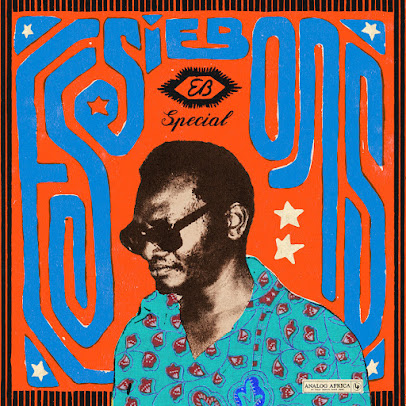
The cover itself is highly
impressive:an arresting, broad-spined gatefold wrought from weighty
textured card, the sleeve is one which presents the prospective buyer
with a definite air of luxury before the records themselves have even
hit the deck. The booklet is likewise a treat, visually impressive and
of stout quality; the reading material is informative and astute,
lending a welcome context to Cameroon Garage Funk's sixteen compositions
that proves particularly enlightening for those previously unfamiliar
with the artists highlighted here.
At over an hour in length, the
compilation's capacious runtime is enough to necessitate its
presentation over two separate LPs. With each side therefore clocking in
at just a little over a quarter of an hour, there's certainly no risk
of the inner groove distortion or other sonic maladies which can
all-too-often plague records where too great an amount of music has been
pressed onto any given side. Indeed, the audio quality is impressive
throughout; remastering has been carried out on each of these sixteen
compositions, lending them a crispness impressive for any recordings of
their vintage.
The auditory quality of the pressings
is likewise excellent; though neither of the two mid-weight black vinyl
LPs sat perfectly flat upon the platter in the case of our example,
both records offer very clean playback, bearing not a single notable
imperfection at any point across the compilation's hour-plus runtime.
Both records were also visually commendable, boasting handsome lustres
free of the surface blemishes which can—rather frustratingly—appear on
brand-new records manufactured at certain pressing plants.
Another captivating compilation from
one of Europe's most important archival labels, Cameroon Garage Funk is a
joy from start-to-finish, both in regards to its electrifying musical
content and its top-notch vinyl release. Classy in its presentation,
thorough in its background research and impressive in its sound quality,
this is an easy release to recommend to any with an interest in
infectious, funky grooves and high-energy auditory workouts.
gigwise.com